Representing the best
Finnish authors abroad
Finnish authors abroad
Finland’s answer to Hitchcock’s The Lady Vanishes
A man on a layover, driven by an obscure professional ambition, finds himself stranded in an airport where utter chaos reigns. A pilot determined to fly his plane to its destination at any cost proposes to him, and to a female passenger equally determined to continue her journey, that they ignore the authorities’ warnings. They then embark on an extremely perilous flight that will take them to unknown territory, to an enigmatic place on the brink of chaos, where violence and the absurd coexist and merge.
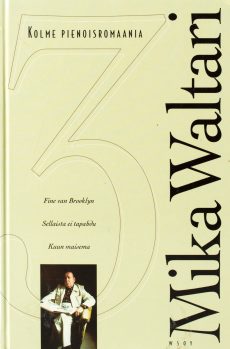
Things Like This Never Happen was written on the eve of the World War II when the geopolitical situation in Europe was explosive. Originally rejected by his publisher WSOY, Waltari first published the novella with the pseudonym Leo Arne in 1944. WSOY finally published the novella in a collection called The Tree of Dreams (Koiranheisipuu) in 1961.
Mika Waltari (1908-1979) is the most popular 20th century Finnish writer who is best known for his magnum opus The Egyptian. Over a career that spanned five decades, Waltari published well over 100 works, of which hundreds of translations have been made. His works include at least 30 novels, 20 plays and 15 novellas, as well as short stories, poems, screenplays and essays. In 1957 he was appointed to the Academy of Finland, having previously won the state literature award five times. Waltari’s works have been translated into over 40 languages.
Finnish PDF
English synopsis
English translation sample
French translation
Reviews
Danish (Jensen & Dalgaard 2025)
English World (Transit Books 2026)
Estonian (Orto 1964 / Katherine 1990)
French (Actes Sud 2015)
Hungarian (Európa 1982)
Spanish (Plaza & Janés 1963 / Navona 2015)
Ukrainan (Folio 2015), rights reverted
“The work is a masterful evocation of the surreal atmosphere of a world on the brink of war, told through techniques later perfected by Samuel Beckett—an endless waiting in a nameless land.” – Politiken, Denmark
“A short, previously unpublished novel, which is almost prophetic. The text is striking in its modernity. It’s reminiscent of Duras, the nouveau roman. It includes anonymous characters, unnamed countries, very little dialogue and enigmatic ‘white writing’, leaving the reader space to fall back on their own imagination. There is no doubt that the work of Mika Waltari… can still surprise us.” – Livres Hebdo, France
“This previously unpublished literary gem, which was written in 1939 by the author of the The Egyptian, follows two individuals who are in a rush to escape the unknown. The travellers discover, and then reveal, themselves in a mysterious world at the edge of chaos, which is far from everything, including themselves. Mystery, poetry and allegory shine a light on Europe before World War II.” – Figaroscope / Le Figaro, France
“In this story, which was written in 1939, a man and a woman board a plane heading to southern Europe. The plane crashes and the two survivors start wandering around a dangerous country in the midst of a war… they encounter many strange people and their journey ends on a river barge with a touring troupe. Where are they? Are they alive? Is this an underworld above hell? Mika Waltari doesn’t answer his readers’ questions, making his novella a premonition of the horrors yet to come.” – Olé, France
“It was high time to give the French public this beautiful book… It occupies a special place in Waltari’s literary canon, revealing a previously unexplored side of the author’s world.” – Actes sud, France
“This little-known book by Mika Waltari is a literary gem… Throughout the novella, the vague and universal overshadow the concrete, creating an imminent feeling of danger.” – Virginie Neufville, Fragments de lecture Literary blog, France
“Those of us who know what happened to gypsies, dwarves and other entertainers between Central Europe and the Balkans after 1939 assume they were living on borrowed time, doomed to annihilation. Our retrospective knowledge brings depths to this strange and beautiful story.” – Pierre Ahnne, Salon, France
“Surviving a plane crash – things like that never happen. Finding yourself in an unidentifiable country in a state of war; dealing with corrupt officials and having to save your own skin by escaping the arbitrariness of a mad situation and a society without any bearings – things like that never happen. The audacious title of this tiny novel (very well) translated from Finnish is both a statement of fact and a wishful thought. (…) both poetic and tinged with lingering vibes of a nightmare.” – Slate, France
“The book’s fascinating narration is engulfed by a poetic, mysterious atmosphere that shines light on the uncertainty that dominated Europe at the dawn of World War II.” – El corso, Spain
“… this adventure is not beautiful: it is full of blood, violence, horror and uncertainty, it is filled with… ugliness and landscapes described in expressionist terms… with characters that seem to come from the Caprichos de Goya or El Bosco’s oniric paintings. This short novel is almost a poem about pain, mourning, searching for the meaning of a wasted life and finding happiness in chaos. It is an existential fable that avoids explanation, leaving them in the hands of the reader’s imagination.” – Alexis Ravelo, Author Littéraire, Spain